The following deliverables are now ready through the project. The following summary gives you a reference to the material. The material will be uploaded to the ERASMUS+ results database. However, you can already get access to the results by contacting the Project Manager.
D5.1 – Course Design and Development for Pilot Training Applying Welding Simulators
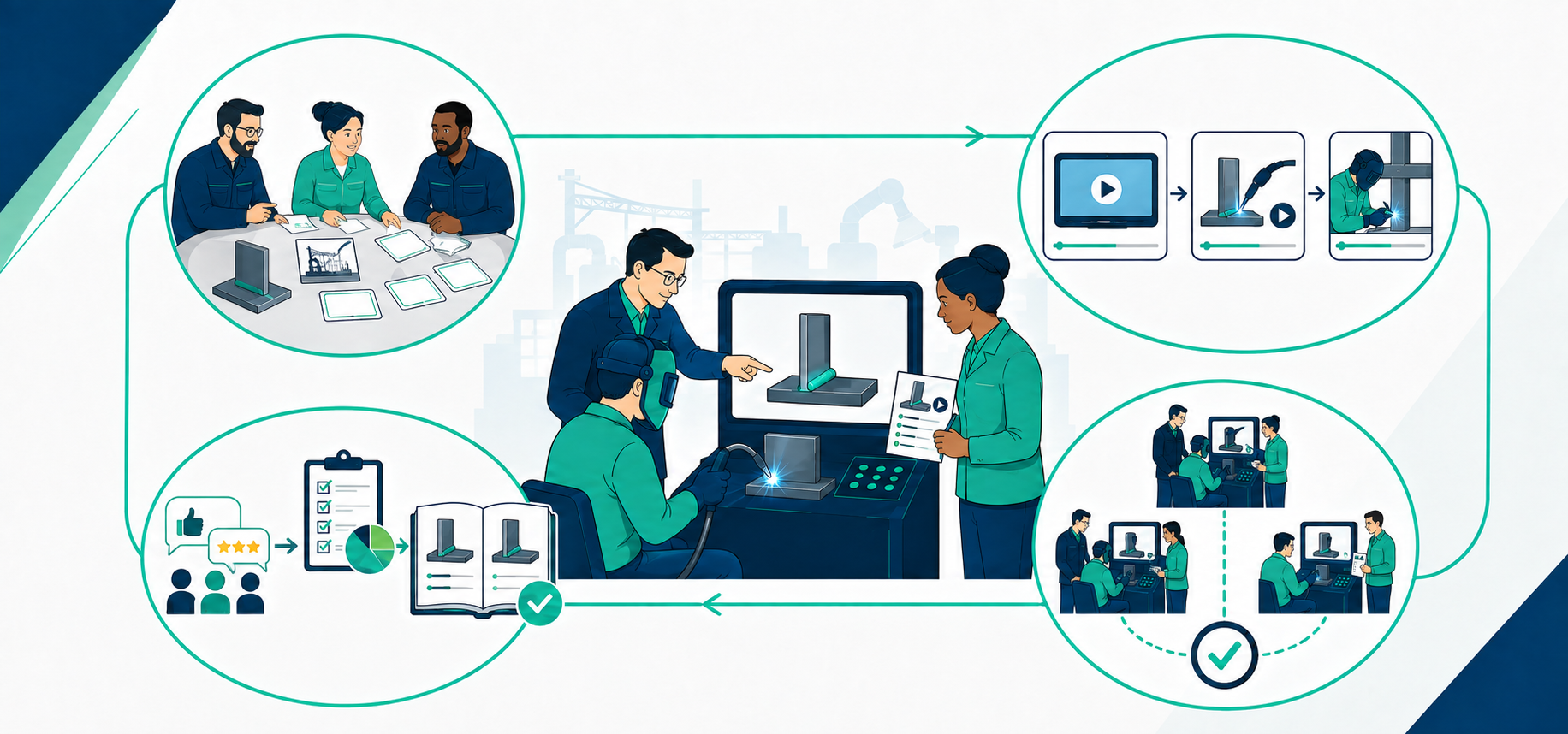
D5.1 defines the methodology and structure for developing the project’s pilot instructor-training course. It covers competence-needs mapping, learning outcomes, assessment design, course materials, teaching methods, admission requirements, quality assurance, learner support and the requirements for teachers and mentors.
The deliverable proposes a task- and problem-centred course with approximately 80% practical activity and 20% theoretical learning. Its modular structure includes simulator introduction, fillet- and butt-welding positions, non-conformity analysis and industrial accident cases, with the possibility of stacking modules towards ISO 9606-1 certification and IIW International Welder qualifications.
D5.2-A – Best practice guideline
D5.2-B – Evaluation of WP4.3 Pilot Course Delivery (HU, RO, SLO)
D5.2 evaluates the implementation of the professional instructor-training programme and converts the results into final best-practice recommendations. It incorporates participant feedback, trainers’ experiences, national and cultural differences, and lessons from the pilot courses to determine how welding simulators, industry cases and blended learning can be applied effectively in different VET environments.
The final output is intended to support the wider transfer and replication of the IQMET methodology in welding education and in other technical sectors that combine simulation, practical competence development and work-based learning.