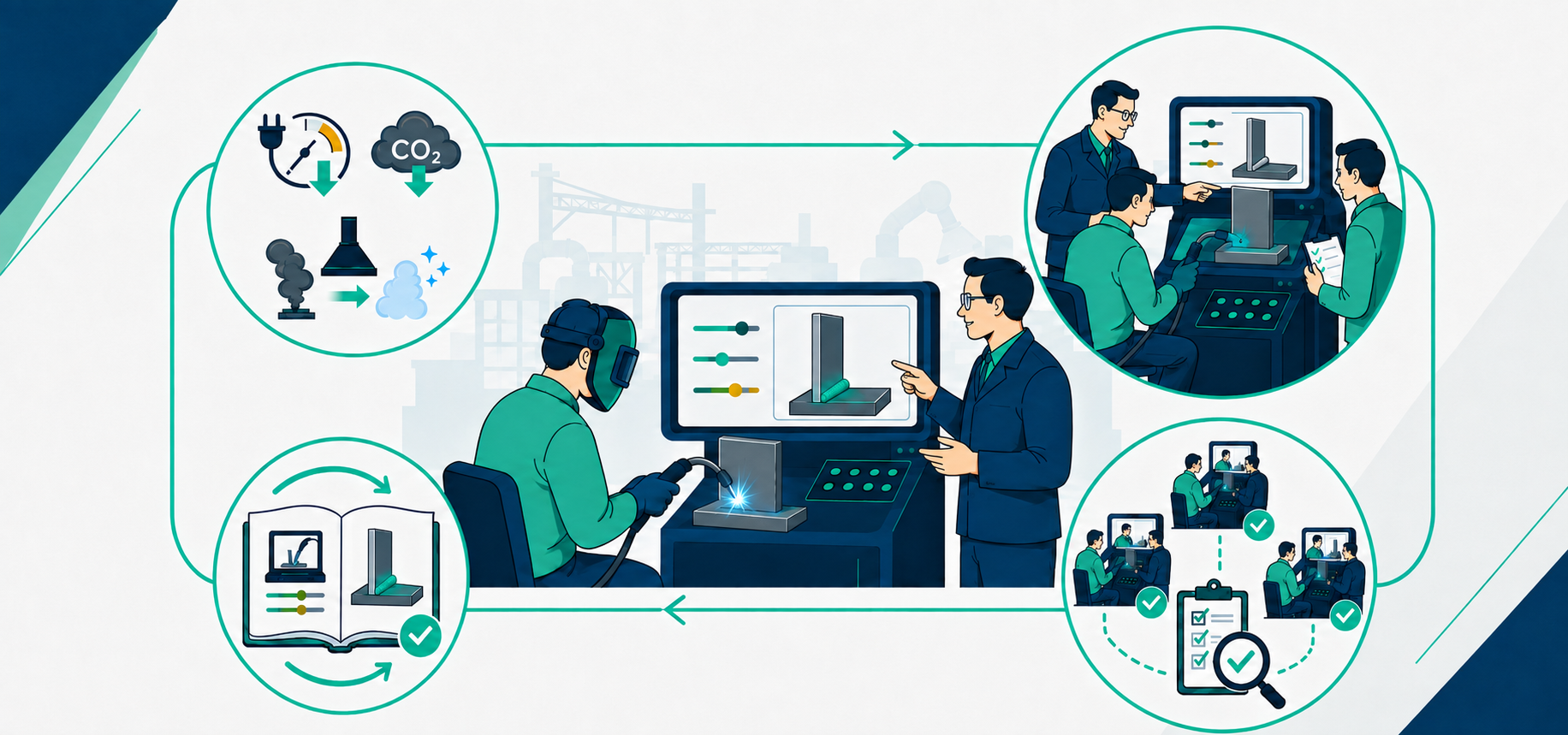
WP4 – Implementation of tools and methods for "greening" of various welding processes
Practical guidelines, teaching methods, and digital tools that enable vocational education and training providers to integrate sustainability into welding education were developed in WP4. The work package focused on helping learners understand the environmental impact of welding processes by incorporating topics such as energy consumption, carbon footprint, emissions, and occupational health into simulator-supported training. Through implementation guidelines, pedagogical scenarios, and pilot activities, the IQMET project demonstrates how welding simulators can support greener manufacturing practices while strengthening technical competence and preparing learners for the sustainability requirements of modern industry.
Deliverables in Work Package 4
The following deliverables are now ready through the project. The following summary gives you a reference to the material. The material will be uploaded to the ERASMUS+ results database. However, you can already get access to the results by contacting the Project Manager.
D4.1 – Guideline for Implementing Welding Simulators in VET/LSP Organisations
D4.1 provides a comprehensive organisational and curricular framework for the introduction of welding simulators into VET and learning-service-provider programmes. It proposes modular and blended training pathways for welding inspectors and international welders, aligned with relevant IIW, EWF, and ISO requirements, and combines online learning, simulation, practical workshop training, digital inspection, and industry case studies.
The guideline also connects simulator implementation with greener fabrication, cost reduction, productivity and quality management. It presents welding simulators as preparation, diagnostic and reinforcement tools rather than substitutes for practical welding.
D4.2-A – Hands on demonstration HU, RO, SLO
D4.2-B – Ideas for teachers, report on the feedback
This deliverable provides demonstrations of the revised welding simulator tools and methods for VET teachers and instructors. The activities allow participants to test simulator-supported scenarios, industry cases and greening calculations, while providing feedback on the technical usability and pedagogical relevance of the proposed approach.
D4.3 – Piloting of D5.1 HU, RO, SLO and comprehensive feedback
D4.3 documents the external pilot courses conducted in Hungary, Romania and Slovenia. Experienced welding teachers and instructors tested the training materials, simulator-supported activities and industry examples developed during the project, while monitoring tools and feedback mechanisms were used to evaluate implementation and identify necessary improvements.
D4.4 - VET implementation WS guideline
D4.4 provides practical pedagogical scenarios for instructors teaching fillet welders and, where relevant, welding inspectors. It addresses the characteristics of VET learners and teachers, simulator-supported training sequences, industry-oriented competence development, written resources, assessment, feedback and debriefing.
The document presents several levels of training, ranging from basic control of torch angle, travel speed and welding parameters to defect analysis, industrial accident cases and broader occupational problem-solving. It recommends a hybrid approach in which simulator practice is repeatedly connected with practical workshop verification.
D4.1 – Guideline for Implementing Welding Simulators in VET/LSP Organisations
D4.1 provides a comprehensive organisational and curricular framework for the introduction of welding simulators into VET and learning-service-provider programmes. It proposes modular and blended training pathways for welding inspectors and international welders, aligned with relevant IIW, EWF, and ISO requirements, and combines online learning, simulation, practical workshop training, digital inspection, and industry case studies.
The guideline also connects simulator implementation with greener fabrication, cost reduction, productivity and quality management. It presents welding simulators as preparation, diagnostic and reinforcement tools rather than substitutes for practical welding.
D4.2-A – Hands on demonstration HU, RO, SLO
D4.2-B – Ideas for teachers, report on the feedback
This deliverable provides demonstrations of the revised welding simulator tools and methods for VET teachers and instructors. The activities allow participants to test simulator-supported scenarios, industry cases and greening calculations, while providing feedback on the technical usability and pedagogical relevance of the proposed approach.
D4.3 – Piloting of D5.1 HU, RO, SLO and comprehensive feedback
D4.3 documents the external pilot courses conducted in Hungary, Romania and Slovenia. Experienced welding teachers and instructors tested the training materials, simulator-supported activities and industry examples developed during the project, while monitoring tools and feedback mechanisms were used to evaluate implementation and identify necessary improvements.
D4.4 - VET implementation WS guideline
D4.4 provides practical pedagogical scenarios for instructors teaching fillet welders and, where relevant, welding inspectors. It addresses the characteristics of VET learners and teachers, simulator-supported training sequences, industry-oriented competence development, written resources, assessment, feedback and debriefing.
The document presents several levels of training, ranging from basic control of torch angle, travel speed and welding parameters to defect analysis, industrial accident cases and broader occupational problem-solving. It recommends a hybrid approach in which simulator practice is repeatedly connected with practical workshop verification.