
WP3 – Testing and evaluation; work based training in AT courses, including industry examples
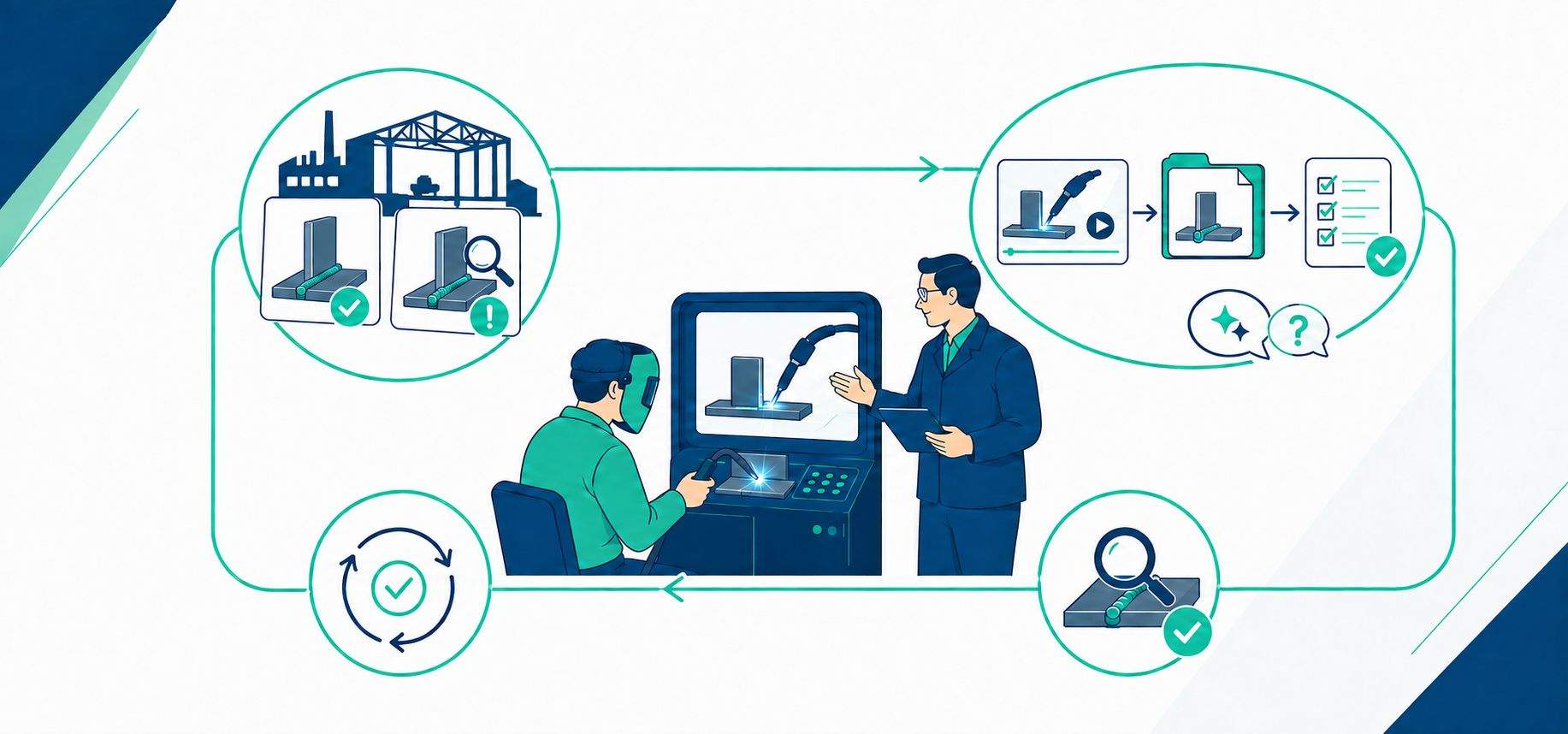
Work Package 3 (WP3) focused on the development, testing, and evaluation of work-based learning approaches that integrate welding simulators (WS) into vocational education and training. The work package produced authentic industrial case studies, competence-based training materials, and pedagogical guidelines that support scenario-based learning, guided practice, and structured feedback. These resources were validated through pilot implementations involving experienced VET teachers and instructors in Hungary, Romania, and Slovenia, ensuring that the developed methodology is practical, transferable, and aligned with industry requirements and international welding education standards.
Deliverables in Work Package 3
The following deliverables are now ready through the project. The following summary gives you a reference to the material. The material will be uploaded to the ERASMUS+ results database. However, you can already get access to the results by contacting the Project Manager.
D3.1-A – Case study overview, questions and answers
D3.1-B – Case study archive
This deliverable develops 16 industry-based cases for use in welding education. The cases include both successful industrial practices and failures or accidents, accompanied by questions and problem-solving tasks that encourage learners to analyse causes, consequences, preventive measures and professional responsibilities.
D3.2-A – Learning materials - AI in welding education. The questions and answers in this document are designed to show what can be generated as answers using AI. Target Group: Teachers for Welding Inspectors and welders.
The examples contain a set of questions with the same core content, and one sentence has been added to each subsequent question, making each more specific.
D3.2-B – Learning materials 3 CU HU
CU-LT-1 – Teaching visual inspection for fillet welders using WSs
CU-LT-2 – Teaching Welding Distortion Causes and Prevention Using WS
CU-LT-3 – Designing Blended Courses with WS and Case-Based Learning
CU-LT-1 – Teaching visual inspection for fillet welders using WSs
CU-LT-2 – Teaching Welding Distortion Causes and Prevention Using WS
CU-LT-3 – Designing Blended Courses with WS and Case-Based Learning
D3.2-C – Learning materials 3 CU RO
CU-LT-1 – Teaching Inspection of Welding Imperfections Using WS
CU-LT-2 – Teaching Welding Testing and QA Using WS
CU-LT-3 – Designing Blended Courses with WS and Case-Based Learning
CU-LT-1 – Teaching Inspection of Welding Imperfections Using WS
CU-LT-2 – Teaching Welding Testing and QA Using WS
CU-LT-3 – Designing Blended Courses with WS and Case-Based Learning
D3.2-D – Learning materials 3 CU SLO
CU-LT-1 – Risk based inspection as a part of plant integrity management
CU-LT-2 – Reinforced steel bars welding and inspection
CU-LT-3 – Control of preheat and interpass temperature
D3.2 contains training materials structured as competence units for welding and inspection education. The materials combine technical content, learner assignments, simulator-supported activities and industry cases, while also defining the minimum competence expected from both learners and trainers.
CU-LT-1 – Risk based inspection as a part of plant integrity management
CU-LT-2 – Reinforced steel bars welding and inspection
CU-LT-3 – Control of preheat and interpass temperature
D3.2 contains training materials structured as competence units for welding and inspection education. The materials combine technical content, learner assignments, simulator-supported activities and industry cases, while also defining the minimum competence expected from both learners and trainers.
D3.2-E – Learning materials supplementary
More than 450 MB of video content has been created. In total, 10 different videos are now available. Six videos focus on simulating fillet weld problems. Four videos focus on how to move the torch correctly for a fillet weld in different welding positions.
D3.3-A – Best practice pedagogical guideline
D3.3-B – Best practice pedagogical guideline WS
D3.3-A and B consolidate best-practice principles for learn-by-doing simulation, work-based learning, learner guidance, feedback and debriefing. It emphasises that simulator exercises must be tied to clearly defined occupational learning outcomes and supported by structured reflection, including the three-stage debriefing model: “What?”, “So what?” and “Now what?”
D3.3-A and B consolidate best-practice principles for learn-by-doing simulation, work-based learning, learner guidance, feedback and debriefing. It emphasises that simulator exercises must be tied to clearly defined occupational learning outcomes and supported by structured reflection, including the three-stage debriefing model: “What?”, “So what?” and “Now what?”
D3.3-C – Greener fabrication process using WS
The deliverable also examines greener fabrication and the contribution of designers, process planners, welding engineers, inspectors and welders to reducing energy use, emissions, repair rates and fabrication costs. It demonstrates how simulator-supported calculations can make the consequences of joint design, weld size, fit-up and repair rates visible to learners.
The deliverable also examines greener fabrication and the contribution of designers, process planners, welding engineers, inspectors and welders to reducing energy use, emissions, repair rates and fabrication costs. It demonstrates how simulator-supported calculations can make the consequences of joint design, weld size, fit-up and repair rates visible to learners.
D3.3-D – Piloting of D3.2 HU, RO, SLO